The job keeps growing
From bioinformatics to full-stack to AI, every step added something to the job and nothing ever left it.
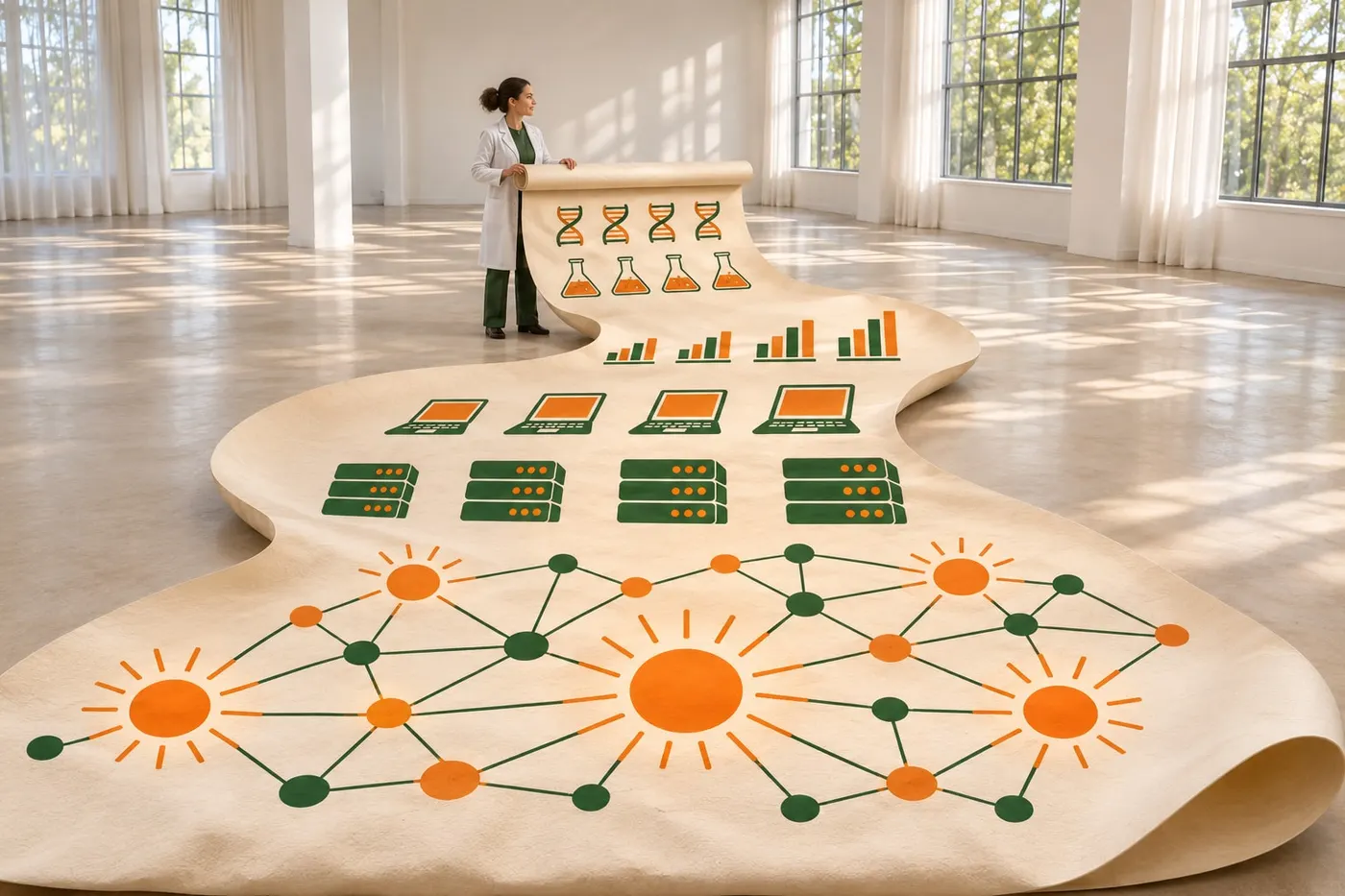
Way back, when I started in bioinformatics, the work usually ended with a result. A plot, a table, a list of genes, the regions that a group of viruses share, which showed how they are linked in function and evolution. Sometimes a small web tool that made the data easier to find, sometimes a p-value that hinted at a new discovery. The job had edges. You needed some biology, some statistics and enough programming to get the data into shape and to help the researchers understand the output. And when the result was a tool for other people, you also needed the IT side of software. A server to run it on, a database behind it, and somebody to keep it all working, which was usually you.
Those edges have been moving ever since, always outwards. More technologies have become available. And every iteration has added something to the job, and nothing has ever left it. Early on I realised that bioinformatics on its own would box me in, and that I would have to keep up with technology as the world changed. Data science seemed to encompass all of it.
The titles keep changing
When I started, I don’t think there even was a field called data science. Working with data belonged to whatever field you were in. Physicists had their own way of doing it, biologists had theirs, and we called ours bioinformatics. Outside science, the people who did this were data analysts.
The title data scientist came later, and it came from industry, not from science. It showed up at the big tech companies around 2008, and a few years later it was being called the sexiest job of the century. Soon everyone who worked with data was one. In practice it meant knowing some statistics, making good plots, understanding a few algorithms and finding your way around the right libraries. That was enough to be useful. If you wrote your own algorithms or libraries, you were already advanced.
And then, just when you thought you knew data science, machine learning took the helm and upped the list. In 2012 a neural network called AlexNet won the ImageNet image recognition contest by a wide margin, and deep learning took over. Google released TensorFlow in 2015 and Facebook released PyTorch a year later. Now you were also expected to know neural networks, training runs and GPUs. R, Pandas and a t-test were no longer the job. They were the minimum. And as soon as anything you built had to be used by someone else, you needed software engineering too. A notebook is not a product.
Two people and a pipeline
My own job grew the same way. At Antion, a university spin-off in Geneva, we developed gene and cell therapies on a platform that could change the expression of several genes from a single genetic construct. I was lucky to be there from the very beginning, before we even had our seed round. We were two people, and the science already had a working pipeline. For someone with a bioinformatics and data science background, there wasn’t much to analyse yet.
So I made myself useful in every other way an early start-up needs. I worked on freedom-to-operate studies, competitor searches, the data room, investor presentations, legal paperwork, hiring, looking for premises and setting up the IT infrastructure, while still doing the data science for our pipelines. I helped close our first investment. None of it was my field, but I was very keen to learn, to be part of a start-up, to build and develop. I learned each piece from scratch, by reading and by asking around, and it took time. Meanwhile the company grew from two people to seventeen.
Then came the software
My part of the science was the silencing sequences inside our constructs. We needed a tool that designed them and predicted how well they would work. I had done bioinformatics, data science and data analysis for years, and plenty of web development on the side. But I had never built a proper full-stack, end-to-end application, the whole thing from the screen down to the server, in a professional setting, and I had never run anything in the cloud. I was the only software and data engineer, so I had to learn that too.
It started as Python scripts that moved into Jupyter notebooks for interactive reports already back at the university. Then it became a web app, then a desktop app, and finally a cloud service on Azure. Along the way I learned Kubernetes and built a custom orchestrator for it in Python. I wasn’t sure I could pull it off. To my own surprise, in three months I had a working version. It was by no means perfect, but it was a start. We took a chance and it paid off. It delivered sequences that worked.
In research the work ended with a result. In software it ends when someone else can use the thing on a Tuesday afternoon without calling you. The gap between the two was bigger than I expected, and crossing it changed how I think.
What actually changed
The languages were the easy part. The hard part was that other people now depended on what I built. An analysis I ran once, checked and handed over. If it had a mistake, I was usually the one who found it. A tool runs every day, for colleagues who don’t know how it works and shouldn’t have to. If it has a mistake, a colleague orders a construct based on a wrong number and a drug might never be developed because of it, and patients will never get the cure they need.
I also learned how much the parts depend on each other. There was the code that designed the sequences, the screen where a scientist types in a target, the login, the server and the monthly bill. I would change one of them and something three steps away would move. Neuroscience had taught me the same thing years earlier. No neuron works alone, and the interesting behaviour lives in the connections. The same goes for people, for that matter.
In research, logging, versioning and backups feel like chores. In a product they are what makes people trust it, because they make it deterministic and repeatable. When someone asks why the tool suggested one sequence last month and a different one today, “I’m not sure” is not an answer. The same goes for where the thing runs, who can reach it, what happens when it falls over and what it costs per month. I used to think of those as details for later, but they decide what you should build in the first place, and how long it will last.
Because I was the only engineer, every feature I said yes to was a week not spent on something else. I learned to ask what the smallest useful version was, and to ship that first. I had one big advantage, though. I understood both the biology and the software. That let me prioritise, and think critically about what to build and how. This is probably nothing new to the many scientists who end up building tools because nobody else will. And AI lets even more of them do it today.
Then came AI
In 2017 researchers at Google published the transformer, the design behind today’s language models. In late 2022 ChatGPT came out, and by the next year people were writing about a new job title.
The first new title was prompt engineer. Frankly, and I apologise for it, at the time I thought it was a bit ridiculous. Today it actually feels like this is the job. More recently came AI engineer. You are expected to know machine learning, and how large language models are built and how they work. That means tokenisation, embeddings, fine-tuning, evaluations. You need to know the infrastructure behind them too, because a model has to run somewhere, for someone, at a cost. You need to know what to pay attention to, not only what the model tells you. And you still have to know the field you work in, because that is where the questions come from.
Feeling always behind
Each of these fields used to be a job of its own. Today they are lines in one job description. Being very good at one thing was once enough. Now, maybe because AI makes it look as if anyone can do anything, you are expected to master all of them. So you constantly feel behind. Every month there is a new model, a new framework, or a new way of doing the thing you only just learned.
I don’t think the answer is to learn everything. Nobody can. Feeling behind is part of the job now, and I’ve stopped expecting it to go away.
Keeping up
So how do you keep up? Maybe by going back to the roots. You learn best by building something. With AI the speed and the scope of building are much greater, so I can try more things than I ever could before. And because I can test more, I think I also make better choices about what to learn properly and what to leave.
And you are still building, even if the model does much of the work. The building blocks have just become bigger. The model writes most of the small pieces, and you no longer need to know how each of them works. If it works, does that even matter? Probably less and less. The complexity has not gone away, though. It has shifted from the small pieces to the big picture. I think this is probably a good thing, because now we can think bigger. Each of us can do a bit of everything.
The slow way
Today an AI model can write most of that notebook, that web app and that cloud setup much faster than I did. If I could go back, would I let AI write it, or would I write it myself? Honestly, I don’t know. Part of me says get it done quickly, move on and learn something new. That is how you keep up. But a second, slightly bigger part cherishes the hard learning I got from doing it myself. In the end it is the hard things you are most proud of, the difficulties you overcame. They give the best lessons.
So we are no longer putting small details together, instead we are building something much bigger, and I hope it gives us as much satisfaction and purpose as before, or even more.